
Accueil>Interview with Louisa Utschakowski, winner of the 2025 MENA Program Master’s Thesis Prize
17 décembre 2025
Interview with Louisa Utschakowski, winner of the 2025 MENA Program Master’s Thesis Prize
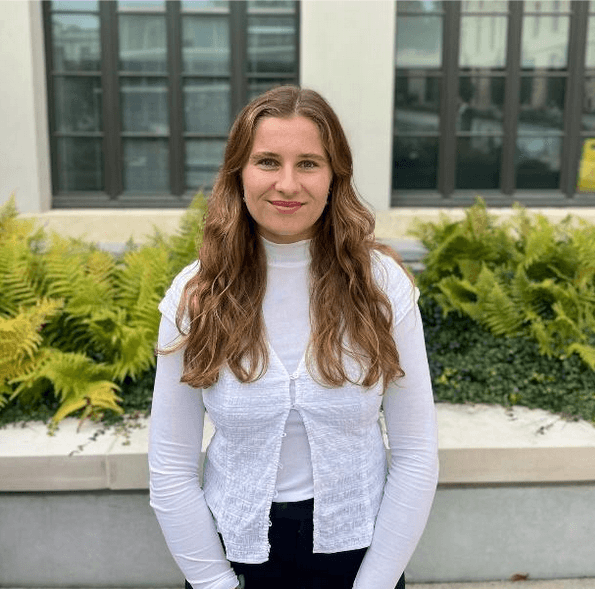
Louisa Utschakowski graduated from the Master in Human Rights and Humanitarian Action at PSIA, Sciences Po, during the Summer 2025. During her studies, she wrote a master’s thesis under the supervision of Prof. Sharon Weill, entitled “Justice from Distance? – Ethnographic Study of the German Universal Jurisdiction Trial against the former Syrian Militia Member Ahmad H.". This work was awarded the first Master’s Thesis Prize from Sciences Po’s MENA Program, recognizing the value of her contribution to the study of transitional justice in the Syrian case, and the quality of her ethnographic approach.
As a Master’s student at PSIA, how did you end up writing a thesis and choosing this topic?
There were two main reasons. The first was practical: coming from Germany, it is very common to complete a Master’s degree with a thesis, especially if you intend to work in the public sector, where it is often a requirement.
The second reason was academic. I saw the thesis as a unique opportunity to devote an entire semester to one project – something I could explore in real depth.
How did you come to write a thesis with such a strong legal perspective, considering that you were enrolled in the Master’s in Human Rights and Humanitarian action, which is more political science oriented?
I have always been interested in the intersection between political science and law. When I started the master’s program at PSIA, I took many legal courses and specialized in the legal dimension of human rights. I also took the yearlong Capstone Course International Law in Action. That is where I met my supervisor, Prof. Sharon Weill, and where I was introduced to the methodology I later used in my thesis: courtroom ethnography. We attended different legal proceedings and criminal trials in Paris, and I grew increasingly interested in this approach. Courtroom ethnography law as it is performed – through the interactions, routines, and power dynamics inside the courtroom – rather than as abstract “law in the books.”
How did you come across the Syrian case and this specific trial of Ahmad H., a former pro-Assad militia member?
It happened somewhat coincidentally. I was looking for cases in Germany for linguistic and practical reasons, and I saw that this trial was about to begin in Hamburg before the Higher Regional Court. I found it particularly interesting that a German domestic court was engaging with crimes committed during the Syrian conflict, based on the principle of „universal jurisdiction“. It also stood out because Hamburg had previously dealt mostly with ISIS-related cases, not with crimes attributed to actors linked to the Assad regime.
You mentioned ‘universal jurisdiction’, which is one of the core concepts of your work. What do you think your research revealed about it?
My research highlighted how challenging it is to conduct universal jurisdiction proceedings “from a distance” – geographically, culturally, linguistically, and emotionally. The court struggled to genuinely hear Syrians and to meaningfully include those most affected by the crimes. Universal jurisdiction can play an important role in transitional justice for Syria, but the trial showed its limitations when proceedings remain largely inaccessible to affected communities.
In the Al-Khatib trial in Koblenz, the first trial worldwide on state torture in Syria, the court engaged in outreach and adopted a more victim-centered approach. In Hamburg, by contrast, the distance remained largely unaddressed. There was no public Arabic translation, no transcript of proceedings provided by the court, and no civil parties; victims appeared only as witnesses. This reduced their participation and limited the broader impact the trial could have had.
How did developments in Syria - especially the fall of the Assad regime - shape the context of your research?
I began working on the topic before the fall of the Assad regime, and these political developments ultimately had no impact on the proceedings, which had almost concluded by that point. The verdict was issued on 18 December 2024, just days after the events in Syria, and the court made clear that they were legally irrelevant for this case.
At the same time, the fall of Assad dominated national media, while the trial itself received very limited attention – mostly short reports once the verdict was announced. This contrast highlighted the tension between major geopolitical change and the everyday routine of a domestic criminal trial far removed from those events.
My thesis was submitted only weeks later, at a moment when debates about the future of justice in Syria had just begun to intensify. It remains to be seen how these recent developments will shape the future relevance of universal jurisdiction, especially if independent and inclusive domestic accountability mechanisms were to emerge.
Regarding your methodological approach, the jury was impressed by your use of courtroom ethnography. What challenges did you face, both regarding access to the courtroom and the analytical work at the crossroads between ethnography and law?
Gaining access posed practical challenges: identifying the trial schedule, finding the correct courtroom, passing through security, and understanding the specific rules governing public access. In Hamburg, observers were placed in a separate room behind the courtroom itself, which meant that certain actors - such as victims and witnesses - were visible only from behind. These spatial arrangements shaped what could be seen and heard, and therefore influenced how justice was perceived, enacted, and negotiated.
Analytically, the main challenge was balancing immersive ethnographic observation with legal analysis. Courtroom ethnography requires attending to gestures, tone, emotions, interruptions, and silences, while simultaneously understanding procedural rules, evidentiary standards, and doctrinal debates. Another challenge was the limited access to actors: I conducted one semi-structured interview with the defense counsel. It would have been important to include more perspectives - particularly Syrian voices - but their presence in the courtroom was minimal, which itself reflects one of the structural limitations of universal jurisdiction trials. Like all ethnographic work, my analysis was shaped by positionality and access.
What are your next steps professionally?
I am currently working as head of office for a Member of the German Parliament (Dr. Bärbel Kofler, Parliamentary State Secretary in the Federal Ministry of Economic Cooperation and Development) until May next year, covering for a colleague on parental leave. After this position ends, I would like to move into a role more focused on human rights, criminal justice, and accountability.